


9 Tips to Write Headlines that Drive More Traffic
A headline is the first thing your audience sees when they find your post. And before your audiences even read your content, they judge it based on the headline, and whether it is worth their attention.
That’s the reason you need to write a strong headline to get your audience’s attention. “Strong headline” here means that it’s a title that grabs attention and is promising them something they’re interested in.
WRITING CLICK-WORTHY HEADLINES VS. CLICKBAIT HEADLINES.

However, there’s always a thin line between writing headlines that are click-worthy, and clickbait. And, a lot of writers end up writing clickbait in an attempt to make their headlines attractive.
Yet writing a headlines that are click-worthy doesn’t mean writing a clickbait. A clickbait over-promises and under-delivers. It is essentially deceiving your audience into offering something your content isn’t backing up, and it just frustrates everyone.
Instead, write a click-worthy headline that grabs attention without deceiving. It is honest and earns readers trust. But it can be challenging to write really good titles without click-baiting, right? Not necessarily. In this article, we will explore how to write non–clickbait headlines that get clicks.
WRITING HEADLINES THAT GET PEOPLE’S ATTENTION.
Regardless of whether you are working with AI to explore ideas, or writing headlines that are fresh from your own creativity, this article has everything you need to know to make your titles catchy and click-worthy.
First, Know Your Audience.

Your audience doesn’t just matter when it comes to the body content. It matters even when it comes to the headlines. It is because different audiences like and prefer different kinds of content and respond to different psychological triggers, language, and formats.
Let’s compare the examples of business professionals and common people to better understand it:
Business professionals don’t need a clever hook:
They just need to know if the content is worth their limited time or not, which is why they are much likely to like a direct and specific headline like: “Optimizing the Supply Chain with Machine Learning: A Deep Dive into Predictive Analytics.” This headline speaks directly and makes it clear what the content offers. It mentions the jargon relevant to the audience’s field — no guessing games for business professionals who are on tight schedules.
However, such a headline (using words like “Supply Chain,” “Predictive Analytics,” etc., which are either unknown or associated with a complex and technical field — can feel intimidating to a more generic audience.
The use of jargon can make it feel irrelevant and out-of-their-knowledge. They might think, “This is not for me.” The lack of a direct, personal benefit also makes it unappealing and something to ignore.
Common people:
Now, think of people who might want to save money on groceries. This particular audience is focused on finding a relatable solution that improves their everyday life, and are not interested in technicalities. In their case, a headline like “How to Reduce Your Grocery Without Eating Less” is more effective.
It is because it addresses a common problem in simple language, using a “how-to” format that feels practical, and promises a clear, beneficial outcome. However, the grocery bill headline is unsuitable for a professional audience because it might sound too simplistic.
Beyond these, there are many kinds of audiences:
- The impulsive social media scrollers who are triggered by more surprising, inspirational, or controversial headlines.
- The niche hobbyist or nerds looking for more specific and in-depth topics;
- The SEO and query-driven audience looking for direct answers to their questions.

Different audiences like different headlines. You gotta know your audience to craft a headline that really hits the spot and gets people clicking
Here are some quick tips to help you do write headlines that work:
- Look at Your Competitors’ Audience. Our rivals are already on the same path as you want to take. Analyze their work, see who’s interacting with them on social media. What’s the vibe of the language they’re using? How are they formatting their titles? This gives you a quick snapshot of the audience you are both trying to reach.
- Use Analytical Tools Web and even social media analytical tools help check your audience’s demographics. Some advanced SEO tools like Google Analytics can provide insights into website visitors’ demographics and interests.
- Conduct Thorough Analyses Different analyses — competitor, audience, and market analysis and research — are useful and even crucial for learning about your audience types and tailoring your headlines.
- Create Audience Personas. Audience personas are detailed customer profiles based on research and data. Make and use these to know their needs, actions, reasons, and aims, and make headlines that match them better.
Additionally, keeping the audience in mind, you want to:
- Match their tone: Like casual for younger or lifestyle audiences, direct and concise for business readers.
- Address their pain points or desires: If readers are looking for a solution, you need to promise them. Headlines that promise solving a problem always perform well.
- Use “you” words: Make your headlines feel personal and relevant where possible. Like “Here’s Why You’re Not Growing on YouTube.” This one speaks directly to the reader.

Second, Use Power Words.
Power words are emotionally charged words that tap into curiosity, urgency, or desire of your audience. These words evolve strong emotions and psychological responses, and encourage readers to act. These are carefully chosen words that grab your audience’s attention and incite their curiosity to click.
Using power words is a subtle technique to increase your headline’s emotional appeal to the audience. It helps in boosting engagement without getting fancy and click-baiting.
For example, words like “secret,” “proven,” “banned,” or “effortless” light up parts of our brain tied to excitement, fear of missing out, or the need for quick solutions.
The heading “6 Proven Ways to Boost Your Blog’s Traffic” uses the power word (proven).
And it’s way more interesting than just saying, “6 Ways to Boost Your Blog’s Traffic.” The first one’s gotta be the winner, ’cause the second one just doesn’t hit the feels like the first one does.
List of Power Words to Use.
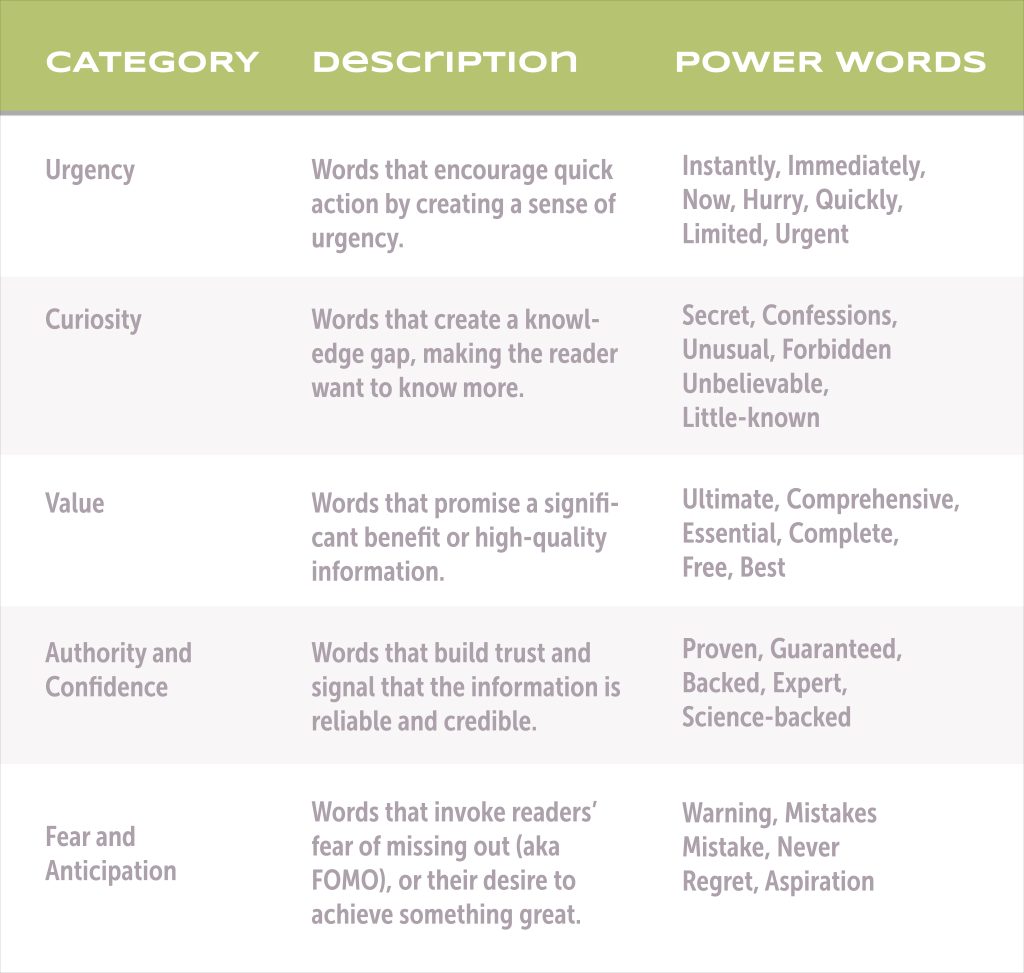
However, overusing power words is not a good practice. Because, more than enough of these can sound like clickbaits. Instead, you need to add them very carefully in your headlines. One or two well-placed power words are enough. So, only use them strategically to grab attention, and not to manipulate your audience.
Third, Be Clear & Specific.
Headlines are best made clear and specific. You want to write the kind of titles that make it clear what the article or post is about and what readers will get out of it, and not titles that play the guessing game. If your headline makes people pause and say “What does this mean?”, chances are, you’ve already lost them.
Vague headings result in friction and lack of intrigue. They can make a user hesitant as to whether to read the content or not. On the flip side, a clear and specific title tells readers exactly what they’ll get from the piece. Your audience is always wondering about “Is this piece for me?” in their minds. So, when your title clearly specifies the topic, it answers the readers’ “Is this for me?” right away.
Let’s take a look at some examples:
Vague: “How to Develop Skills and Earn”
Specific: “How to Unlock Your Hidden Skills and Land a Better Job”
Vague: “5 Upcoming Tech Trends”
Specific: “5 Tech Trends That Will Change Your Life by 2026”
Vague: “The Best Ways to Be Productive”
Specific: “10 Productivity Hacks to Finish Your Work Faster and Save Time”
Be specific and tailor your headline specifically for your audience when writing.
Suppose you’re writing for new parents. Here, a title like, “7 Ways to Get More Sleep” is specific in general, but not exactly for the target audience (new parents). So, in the case of parents, a more specific title would be:
“7 Sleep Training Methods for Babies That Actually Work.”
This title works better since it speaks directly to “parents.” It also mentions “sleep training” and “babies,” which are keywords relevant to them. This specificity of the title makes it more relevant, making it more clickable for the specific audience.
Think about the specific benefit your readers will get and use it in the title.
The key lies in making your headline relevant to the audience, simply by addressing their concerns and benefits.
Fourth, Include Numbers and Specifics
Humans love numbers. They like reading titles like “top 10,” “5 hacks,” and “7 tips.”

Why? Because our brains are instinctively more drawn to numbers because they signal that the content is concrete, organized, and perhaps easy to digest (quantified value); number-based titles also provide quantifiable value, which appeals to our desire for quick, easily digestible information, such as a list of tangible takeaways, and not a long essay.
Numbers also add to the headline’s specificity. They reduce the guessing game, so when readers see a title like “7 Ways to Grow Your Email List,” they know just what they’re getting, which are seven different ways that can be used to grow email lists.
A title like this is much more appealing than “Tips to Grow Your Email List,” making no promise of a specific format or quantifiable information.
Write “5 Actionable Tips to Achieve Work-Life Balance in One Week,” and don’t write “Actionable Tips for a Better Work-Life Balance.
“The second headline uses a number with a specific time frame of one week. It makes it more compelling.
Don’t just add numbers, use odd digits like 5, 7, and 9, because odd numbers are more intriguing and tend to perform better than even numbers, while digits like “5” are more attention-grabbing than words like “five.”
Examples:
- “7 Hacks to Instantly Make Your Content More Engaging”
- “3 Mistakes New Freelancers Make (And How to Avoid Them)”
- “10 Tools Every Social Media Marketer Should Know”
Fifth, Ask Questions.

“How-to” is arguably one of the best headlines format to this date; people love “how to” titles because they are direct, helpful, and written just how most users search for them. Similarly, asking a question in your headline draws readers in by triggering their curiosity and self-reflection.
One of the reasons why this format is successful is because it poses the topic as people think of it.
Take for example, if someone searches for how to increase food intake, they’re most likely to like a headline which directly answers their internal question, like: “How to Increase Your Food Intake in 2 Weeks.”
It feels like a direct answer to their internal question, which is just the thing they’re looking for. Such headlines are powerful because they create a direct dialogue with readers.
Here are some tips to help you make question headlines work for you:
- Promise a solution in the headline. Don’t just raise the question in the headline, but also hint at the solution hidden in the content to intrigue the audience. For example, the question in the title: “Stuck While Writing? Here’s How to Overcome Writers’ Block.” draws readers in, while the “Here’s How” promises a solution and gives them a reason to click.
- Use them for list-based content. Question headlines can work well with listicles. For instance, “Are You Making These 10 Common Investment Mistakes?” These titles hook readers with a question and use numbers to promise a specific list.
- Examples of question headlines:
> “How to Write Viral Tweets Without Sounding Desperate”
> “Why Isn’t Your Blog Growing? (Here’s the Real Reason)”
> “How to Stop Writing Boring Headlines And Get More Clicks”
> “How to Save 10+ Hours a Week Using AI Tools”
Sixth, Optimize for SEO.
Click the image below to watch out video on what goes into good on-page SEO

SEO is Search Engine Optimization. Making content (including Meta Titles) rank higher on the web leads to more clicks.Use tools like Ahrefs/SEMrush or their alternatives to research keywords, understand what people type and phrase their search queries when looking for a topic.
Optimizing Meta Titles.
While all the tips shared above work and can be implemented, SEO matters because it gives you insights based on real user activity. And sometimes, people don’t exactly search for something the way you’d do. So, while you can create headlines by guessing how your topic might get searched, which can be amazing, but they can easily fail if the vast majority of people are phrasing their query differently.
For example, you might come up with the title: “4 Methods to Cook Coffee,” while people are searching the same thing using different words, like “4 Ways to Brew Coffee.” Statistically speaking, which one will get more clicks?
Don’t shoot aimless arrows. Use SEO tools to get real insights and use them to brew your headline instead. Here are some tips:
Research All Keywords: Make sure you’re looking up all the different phrases your topic can be searched for. This will allow you to find the best one.
Evaluate Search Volume.
Search volume is a calculation of the amount of searches a keyword is getting. Some keywords have high search volumes, while others have low. High volume means more people are searching for a keyword. Although high-volume keywords are often difficult to rank for, they also bring more clicks when you outperform your competitors.
Combine Keywords: Your headline doesn’t need to have just a single keyword. You can use two or more keywords in a single title by writing them strategically. Also, it’s okay if some keywords get spit. For example, suppose you find five keywords related to brewing coffee:
- coffee brewing methods
- best method to brew coffee
- easiest method to brew coffee
- 5 methods to brew coffee
- easiest method to brew coffee at home
You can combine all of them to form one comprehensive title: “Coffee Brewing Methods: The 5 Best and Easiest Methods to Brew Coffee at Home” This title combines the power of five different keywords with similar intent. Notice how it also includes an odd number, which further makes it intriguing.
Optimizing Meta Descriptions.

In addition to keywords, pay attention to your meta descriptions. Meta descriptions are short descriptions about your content that appear beneath your titles. More often than not, people read descriptions along with titles. This is why attractive meta descriptions can increase their likelihood of clicking the title.
On Google, meta descriptions are capped at up to 160 characters, that’s why optimizing them is a tricky task. Here’s how you can optimize yours:
Summarize Your Content’s Value: Your description needs to be brief in explaining what the page is about and also what the reader will gain from clicking. Since meta descriptions don’t have much space, you need to use strong sentences to tell them why your content is the solution to their problem.
Keep It Short but Descriptive.
Keep your description concise and to the point to make sure your entire description is visible on SERP (a longer description gets cut off). So, you need to make sure you’re keeping it within the 160 character limit. Remember, a short and impactful description is often better than one that gets cut off mid-sentence.
Include Your Primary Keyword: As with headlines, make sure you’re placing your main (and also secondary, if possible) keywords in the description. This helps when users search for the primary keyword; the search engine often bolds the keyword in your descriptions. It makes your description prominent and appear more relevant to users. Learn about the exciting world of keyword research here.
Add a Call To Action.
Always end your description with a suitable call-to-action (CTA) phrase to encourage users to click. These are phrases like “learn how to…,” “Find out more…,” “Get the complete guide,” “Click to learn more,” etc. Good CTAs are an effective way to drive clicks because they guide users on what to do next.
Leveraging SEO can really boost your headlines’ clicks rate, while keeping them interesting and catchy.
Seventh, Avoid Robotic Language.

AI tools are particularly good at generating headlines. However, a lot of times, sheer-AI headlines can sound unnatural, especially because AI tools are known for stuffing titles with commonly used AI terms.
While grammatically sound, these titles can feel redundant, because they usually are and also because a lot of people are using these titles everywhere unfiltered. Using raw AI-generated headlines can even divert people and leave them with a bad impression; since many people find AI content “slop” (which means low-quality content), reading a title that sounds robotic can make them think that the underlying content is also AI copy-paste, which is a clear loss of trust.
AI-generated headlines might sound unnatural, like:
- “Effective Strategies to Increase Engagement Metrics on Your Social Media Platforms”
- “Harnessing the Power of AI: How to Leverage AI Tools for Effective Writing”
Meanwhile you want titles that sound natural, have personality, and feel human-written to maximize their clicks. You can accomplish this by humanizing AI text — manually or by using an AI humanizer tool — and making them sound natural, which you can do by rewriting them the way people talk. This includes removing the AI terms and using natural phrasing to rephrase the text.
Like the following two examples:
- “Smart Ways to Get More Likes, Shares, and Comments on Social Media”
- “How to Use AI Tools to Write Better”
Notice how the above headlines sound much more engaging and natural, even though the second title becomes shorter. People are more likely to trust these titles compared to the AI-generated ones.
Eighth, Keep Headlines Original.
While trying to write the most catchy headline, don’t forget about making them original, and not plagiarized.
When the internet is already full of hundreds of repetitive and low-quality titles, this is your chance to make your headlines sound original and stand out. Otherwise, a redundant or copycat title is much likely going to just blend into the noise with others. Repeating someone else’s words can also give readers an impression of lazy work.
On the contrary, making headlines originally can show creativity, reflect your voice, and also perform equally or better online.
Here are some tips to make your headlines original:
- Tweak Existing Ones: If an existing headline inspires you, you can tweak its tone and restructure it for uniqueness, or rewrite it from a different angle.
- Use Your Voice: Use your unique voice in titles by rephrasing them in your style or brand tone.
- Don’t Reuse Exact Titles: Don’t copy existing titles word for word, especially the ones you’ve seen in top-ranking articles. Unless it is for SEO reasons.
- If you’re relying on existing works or AI suggestions, check for unintentional plagiarism and run the content through a plagiarism remover to make sure it maintains originality and uniqueness. Because, some users tend to check more than one title on the web.
- And if yours is unique, it can inspire them to click.
Ninth, Avoid Clickbait Headlines.
Writing a clickbait title is the last thing you want to do for a catchy title. Because nobody likes to be tricked, not even by a headline.
You must have seen those too-good-to-be-true titles when scrolling the web. And 99% of the time, they are actually too good to be true. This is also true for others; people do understand and avoid when something seems fishy. And even if they don’t, the moment they land on your page, it’s clear that they’ve been tricked.
It is true that clickbait titles can get a good amount of clicks. But what happens next? Those clicks only last a few seconds and readers lose trust. I mean, if your headline reads something like “life-changing secret” or “gain 1000 subscribers in 10 minutes,” but the article only scratches the surface, your audience will not stay and trust you.
This is the reason you don’t want to write over-promising titles — titles that sound too good to be true. Like these:
- “This Trick Will Make You a Millionaire Overnight”
- “These Stories Will Change Your Life Forever”
Instead, write titles that sound believable and not overpromising, while teasing readers just a little to make them click, like these:
- “Here’s What Most Millionaires Did Before They Turned 30”
- “3 Inspiring Stories That Will Broaden Your World-View”
The goal is to intrigue readers, not dupe them, which means, you will only make a bold promise if your content delivers it.
And finally…
Writing strong and attractive titles is vital if you want people to click your content and read it. This article explains how you can make your headlines catchy: by tailoring them to your audience’s preferences, using “power words,” and making them clear.
In addition, adding numbers and specifics, asking questions, optimizing your headlines for SEO, avoiding robotic language, making them feel original, and steering clever of clickbait can further enhance your titles and make them compelling.
This is guest post written by Simon Butler, and he can be reached at simonbutler476@gmail.com